

A robotic assistant supporting patients in the public healthcare system
Robotic Hospital Assistant|AROH
Centro de Investigación y de Estudios Avanzados (Cinvestav) & Centro de Investigaciones de Diseño Industrial
Industrial Design Thesis Worker
Mexico City, Mexico | 2014
Objective: to design and manufacture a robotic hospital bed prototype for public healthcare in Mexico that complies with all FDA safety standards and enhances patient monitoring and recovery.
Contribution: design research, railings design, infographics, ergonomic analysis, renders, video animations, 3D CAD SolidWorks, prototype manufacturing, and bachelor thesis.
In Mexico’s public healthcare system, approximately 80% of hospital beds have been in use for over 24 years. These outdated units struggle to respond to the growing demands placed on hospitals by a large and diverse population. As a consequence, nursing staff are required to manage an excessive number of patients, often relying on equipment that does not support efficient care or monitoring.
From a design perspective, many of the hospital beds currently available on the market are developed using European or American anthropometric standards. This results in products that do not adequately accommodate the biomechanics, body proportions, and postural needs of the Mexican population across different bed positions. Furthermore, their high cost, typically denominated in US dollars or euros, limits accessibility and places significant strain on public healthcare budgets.
Extensive research for medical devices
The project split into two groups working in parallel. Cinvestav engineers were in charge of the mechanisms, and CIDI's team the aesthetic design, ergonomics, and interaction. Through a Human-Centred Design approach, we performed extensive research activities, such as:
Field research at "Hospital Juárez de México".
Desk research related to pressure ulcers.
In-depth interviews with hospital nurses and physicians.
U.S. Food & Drug Administration (FDA) safety standards study.
Carry out an anthropometric sampling of the Mexican population.
AROH design
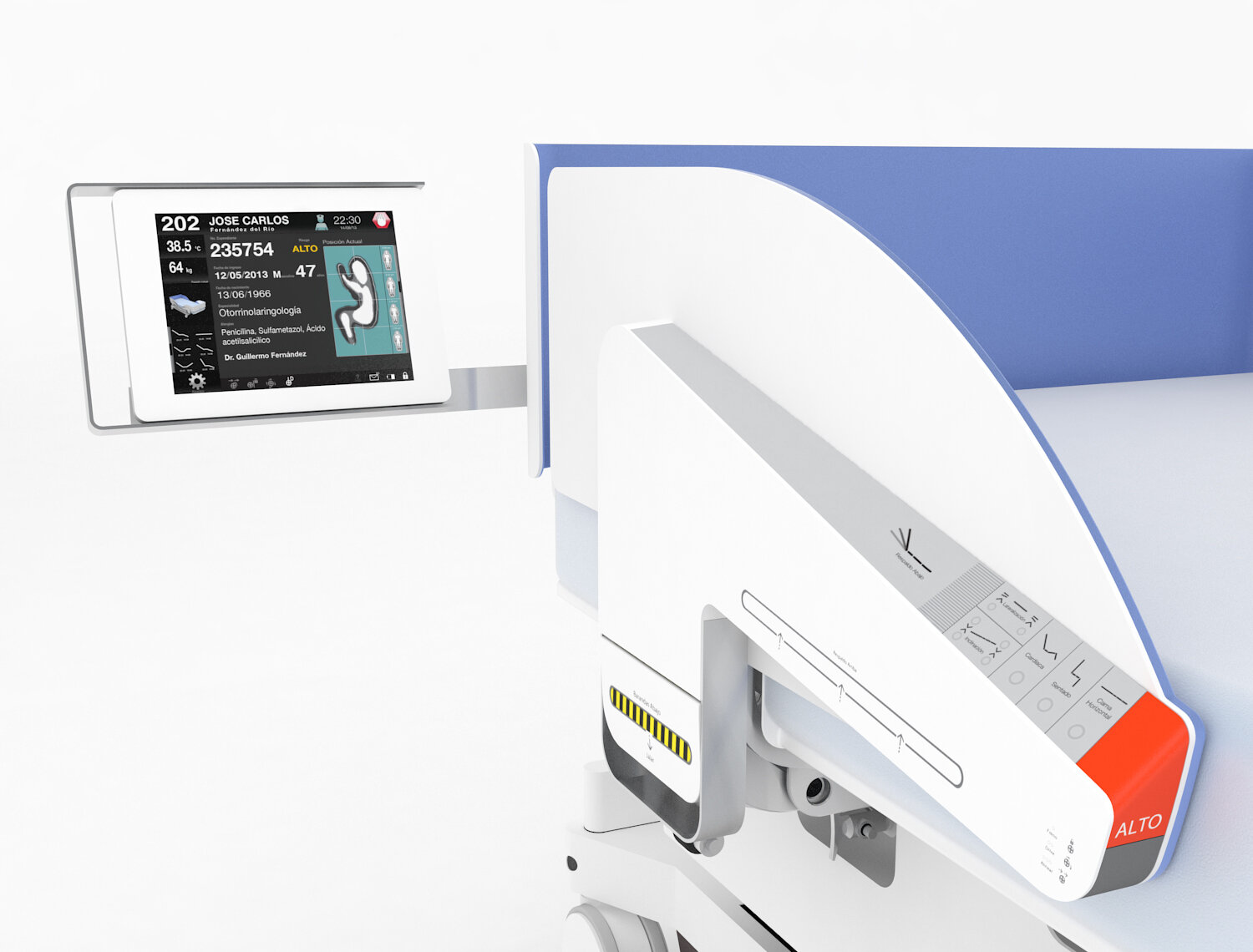
In Mexico’s public healthcare system, patients typically share hospital rooms, making privacy a crucial consideration in the design. For this reason, the side rails were conceived to create a sense of shelter for patients during recovery, while simultaneously ensuring protection against falls.
Furthermore, the integration of the lower side rails with the footboard allows medical staff easier access to the patient, facilitating transfers and enabling more efficient examinations and check-ups of the lower body.
Twelve different positions

AROH can perform twelve medical positions, controlled by two independent systems integrated into the screen and the side rails. In addition, the mattress incorporates a mesh sensor connected to a computer, which monitors the patient’s condition in real time and adjusts the bed’s movements accordingly to help prevent pressure ulcers.




AROH design team!

Héctor López, Adolfo Gutiérrez, Héctor Dorántes, Mara González, Eduardo Ornelas, Manuel Rosales, Germán Rostán & Mónica Soto.
Back to: